












Hungary to Hold National Consultation on Tisza Party Tax Plans
- 8 Sep 2025 4:54 PM
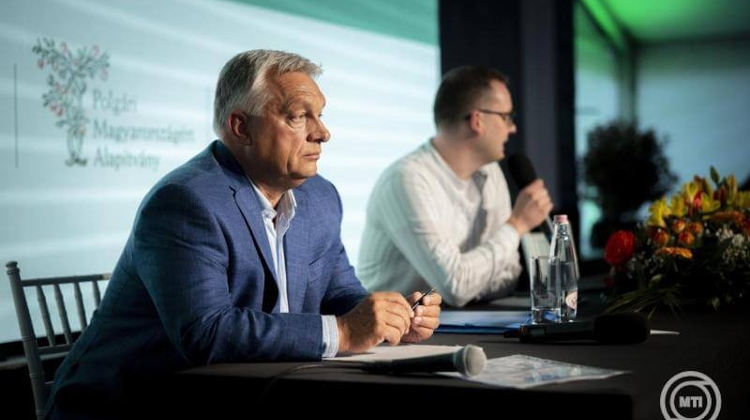
Next year's election is about trust, too, and the opposition has suffered a complete loss of trust, Prime Minister Viktor Orban said in a speech at an event in Kotcse, in western Hungary, organised by the Foundation for a Civic Hungary on Sunday.
At the event, Orban said the government would launch a National Consultation survey on the opposition Tisza Party's leaked tax plans.
Orban said the opposition had brought "secrecy and stealth" to the political season and warned that those "who walk in twilight and darkness have bad intentions".
"We have always done what we said and said what we have done," Orban said, highlighting the government's steps to "send home" the IMF, create one million jobs, keep Hungary free of migrants, stay out of the war, protect children, support families, cut taxes and reintroduce the annual pensioners bonus.
He said the trust earned in this way was the reason the governing alliance had won serial elections.
"What we promised, we delivered, that is what makes up the essence of politics, which is confidence," Orban said. Concerning his opponents, he said "Gyurcsany and his people were more clever, they only revealed after the election that they had deceived voters, while Tisza made it public before an election."
"They are offering their own head on a silver tray ... why not accept it," he added.
Orban said that political parties that had lost the trust of voters "have nothing left but provocation" and noted opposition Tisza's rally held earlier in the day at Kotcse, where ruling Fidesz has held its annual meetings for years. "They come here, because nobody believes what they say any more, but if they come here, there will be tension, a conflict ... that is what they have left; we need to be prepared that this will be their policy for the next seven months," he added.
"The United States is now dismantling the global economy in which we have lived so far, and regional economies are emerging worldwide," Orban said. He said the new strategy of the US, brought about by Donald Trump's presidency, meant that the export of democracy was "finished". "They don't seek to lecture anybody, they don't want to dictate what political system is right; every country has its own culture, they should have the systems they want," he added.
"America is returning to a policy of great powers; their behaviour is no longer governed by international regulations, they see the world as one with players, powers, influences and an ability to project power, a power to be used," Orban said.
He said the US was "facing the facts" such as China's "irreversible advantages" in terms of its demography, technologies and amassed capital, and its decreasing military disadvantage. The US has also faced the fact that "Russia has won the war" and its victory could not be reversed without deploying hundreds of thousands of land troops.
The US has also realised that "it is possible to make business deals with Russia, but the Russians will not be isolated from China in the next decades ... the US is losing ground in the Pacific, and the EU is weak and will stay so," Orban added.
According to the prime minister, the European economy is not likely to "get up", while "Germany's new chancellor has recently declared the end of the dream of a welfare state." In Poland liberal oppression is nearing its end, and in Czechia "Babis ante portas," Orban said, adding that "the Russian president will remain in place."
Concerning the war in Ukraine, Orban said America's previous, Biden administration had "openly advocated setting up a different political regime in Russia". "By now this has become a financing competition between the EU and Russia, in which the Russians are on the winning side just now. This situation will weaken them but we will be crippled," he added. Ukraine is being divided up, he said.
"While the Europeans now elegantly talk about security guarantees, it in fact means cutting up Ukraine," he said, adding that "a Russian zone has already been set up on 20 percent of Ukraine's territory."
Orban highlighted the EU's declining share of global GDP compared to the US and faulted the leadership in Brussels.
He said the EU had entered a state of disintegration and fragmentation. "If it goes on like this, and there is a good chance it will, the European Union will enter history as the disappointing result of a noble experiment," he added.
He said the EU had failed to achieve the goal set when it was established: to create a global political and economic power. He added that a free trade zone "from Lisbon to Vladivostok" hadn't materialised, and the euro hadn't lived up to expectations as there was a common monetary policy, but no common fiscal policy.
Even if a budget is drafted for the period 2028-2035, Orban said "that could be the last if nothing changes" and warned that the disintegration of the eurozone could follow in a "chaotic and costly process".
He proposed transforming the structure of the European Union into one of concentric circles.
He said such a system could mean the survival of the concept of European cooperation and the EU for the next ten years. Without it, he warned the EU could "split apart".
Orban noted that an EU of concentric circles was not the same as a "multi-speed Europe" and explained that countries on the perimeter in such a system would cooperate in just two areas: military security and energy security. That circle could include Turkiye, the United Kingdom and "horribile dictu" Ukraine, he said.
Orban said the second circle would include countries that were in the common market, and the third countries that wanted a common currency. The fourth circle would include countries that want to harmonise their principles and form a political union, he added.
Orban warned that Ukraine's EU accession would draw the community "directly or indirectly" into the war.
He said it would be impossible for the other members not to help a peer attacked or in conflict, adding that "whether Ukraine is under a military attack or if it is in conflict with Russia will never be decided by Ukraine but by Russia, always."
"The EU is not working to make itself concentric but to save its current form," Orban said. "What we see is a last, desperate attempt to stay together, through shared indebtedness," Orban said. "A shared debt qualifies as statehood, that is how the United States came into being," he added.
"In addition, they think that Ukraine is the best tool for becoming jointly indebted. We should not only see the war, and geopolitics, but the future of the EU," he said. He also suggested that the leaders of the EU "think that the most convincing reason for becoming indebted, at least in western Europe, is security".
Offering a prognosis for the years ahead, Orban said the EU would have a a minor role in global politics, while its most important member state, Germany, tried to manage the end of the welfare state. He added that the establishment of parallel societies was at an advanced stage and warned that parallel legal systems would follow.
Concerning the war in Ukraine, Orban said the Russian goal was to prevent the West from gaining ground, while China's goal was to change a world order dominated by the United States into a multi-polar system and ensure privileged access to the Russian economy.
Ukraine's aim is to ensure financial aid continues and to avoid a collapse of their economy, Orban said, adding that Europe's aim was to help Ukraine maintain its military capabilities and keep the US involved in the conflict. He said Donald Trump's goal was to negotiate economic matters with the Russians and to keep the EU subordinate in economic terms.
As long as the war in Ukraine lasts, the European Union will stay "a lame duck", as it depends on the United States in terms of security, Orban said.
Without US assistance, Orban said the EU was not only incapable of resolving the issue of Ukraine, it could not even ensure its own security. He added that because of its vulnerable security position, the EU could not have an autonomous trade policy, as reflected in the US-EU tariff negotiations.
Orban said the EU should not "seek favours" in Washington, but "go to Moscow and negotiate an EU-Russia security agreement". Such an agreement should stipulate that "Ukraine will not be a NATO or EU member," he said, but added that Ukraine and the EU could sign a strategic partnership agreement, which Hungary would support.
He said the Hungarian government did not want to "toss Ukraine into the void" and was not "anti-Ukraine", but wanted to ensure a future for Ukraine, warning that the collapse of the country would present a "huge risk" for Hungary's neighbourhood to the east.
Orban said that continuing the war would be a "losing strategy" for Europe. "The US president has only to ask for coffee and call for his European underdogs to report. This is what is happening, and will continue unless we change it," he added.
Orban said the Hungarian economy had managed to avoid bankruptcy, because it had detached from the European economic model in time, in 2010. He explained that the European economic model was that of a welfare state, while Hungary's was a work-based one with a flat-rate tax, family support and subsidies for home purchases.
He said Hungary had two alternatives: "the first is that we attach Hungary's carriage to the European Union's train" or "stick to the model that the incumbent government parties have built."
Proceeding with the EU, "heading for the abyss", would involve "restoring a welfare-based economy, accepting Brussels' economic demands, adopting the euro, saying good-bye to sovereignty, giving up regulated household utility prices, reconsidering the annual pensioners bonus, introducing tax brackets, giving up Russian energy and changing family subsidies," he said.
In that case, Hungary would also need to accept "Brussels' war demands" and "give money to Ukraine, send soldiers to Ukraine and allow Ukraine into the EU," he added. "This would mean a common war, common debt, common economic policy and common funds," Orban said.
As the other option, Hungary could stick to its own Hungarian programme and mission: a work-based state, common market but national economic policy, staying away from the war and from shared debt, with no EU membership for Ukraine, but a strategic partnership, national energy policy, rejection of migration and a mixed society, together with child protection, reorganising the V4 and cultivating special ties with the US and China, Orban said.
Orban said Fidesz already had candidates in all 106 individual constituencies and that they would win in 80 if elections were held today.
"That guarantees stable governance," he added.
In addition to candidates, Orban said they had a strong digitally-based community of people as well as targeted economic programmes.
He said the government had to postpone its targeted programmes by six months due to the EU sanctions and the war in Ukraine, but pledged "to implement everything, albeit with a half-a-year delay."
He highlighted tax exemptions for child support subsidies and for mothers, bigger tax allowances for families raising children, a subsidised credit scheme for first-time home buyers and food vouchers for pensioners.
He said the ruling parties had fulfilled all of their promises and not governed badly, but added that "having a good chance" was not enough.
The prime minister said the government had to accelerate its expansion in the digital space. "If we don't go there, and our opponent does, we will not win," he added.
He said there would be peace marches, policy debates demonstrating the ability to govern and mobilisation of voters in the next seven months.
Orban warned that Hungary would be ruined if it got a "stupid" government. He urged people to keep in mind during the coming seven months that Hungary was a country of ten million inhabitants with no natural resources in the middle of an unstable region. "Our home is the kind up country that requires special leadership skills," he added.
Orban said shared victory had to take priority over everything else and urged everybody to make every effort they could. "You know me, there are people that make threats and are rude, but believe me, nothing will be forgotten. Note will be made of everything and everything will be settled," he added.
Orban said that following the coming victory, the V4 would be strengthened and the Patriots in Brussels doubled, while taking the city over. He promised an "exciting presentation" on the topic in the autumn of 2026.
Source: MTI – Hungary’s national news agency since 1881. While MTI articles are usually factual, some may contain political bias, and readers should be aware that such content does not reflect the position of XpatLoop, which is neutral and independent.
Since the goal of XpatLoop is to keep readers well briefed, right across the spectrum of opinions, MTI items are shared to ensure readers are aware of all narratives within the local media.
XpatLoop believes in empowering readers to form their own views through complete and comprehensive coverage. To facilitate this XpatLoop has a balanced range of news partners, as you can see when you surf around XpatLoop.com
*********************************************************************************************
You're very welcome to comment, discuss and enjoy more stories via our Facebook page:
Facebook.com/XpatLoopNews + via XpatLoop’s groups: Budapest Expats / Expats Hungary
You can subscribe to our newsletter here: XpatLoop.com/Newsletters
Showcase Your Business to Expats in the Loop:
As an independent portal we’re grateful to all commercial supporters who help keep you in the loop with fresh insights and inspiration. Do you want your business to reach tens of thousands of potential high-value expat customers? If so please contact us here.



LATEST NEWS IN current affairs