














Orbán: Budapest Peace Summit on the Horizon
- 24 Nov 2025 7:07 AM
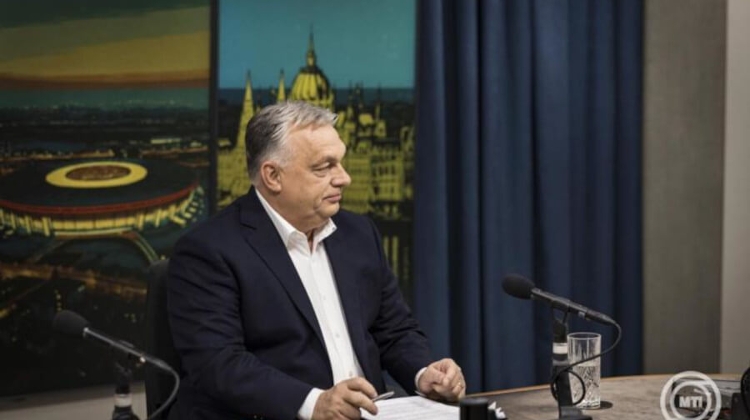
Hungary's prime minister has said that a Budapest peace summit was on the horizon and the next 2-3 weeks would now prove "decisive", now that the existence of the 28-point peace plan had been confirmed.
In a Friday interview to public radio, Orban said the 28-point American peace plan containing joint US-Russian proposals had been officially confirmed on Thursday evening and handed over to Ukraine.
"The next 2-3 weeks will be decisive," he said, adding that the first official reactions soon would be made. "The Budapest peace summit is approaching," he declared.
Regarding the corruption scandal in Ukraine, Orban said two things about the operation of the Ukrainian war mafia had been revealed: large sums of European and US money had disappeared and had not reached their intended destinations; and Europe did not have a control mechanism for tracking where the money went.
Orban: Europe must be prevented from entering war
Europe must be prevented from entering the Russia-Ukraine war, Prime Minister Viktor Orban said in an interview to public radio on Friday.
While all current problems were rooted in the war, he said, "the biggest problem is that Europe has decided to go to war".
He added that the American peace proposal, or a ceasefire and peace ending the Russian-Ukrainian war, was no longer just about saving lives lost on the front or a bid to stop burning money on an unwinnable war, but also about keeping Europe out of the war.
"We must turn back from the dead end that European policy has reached," he said.
Orban noted he had written a reply to European Commission President Ursula von der Leyen's request to member states for further funds for the war, adding that his response was "not only a flat rejection" but contained his reasons for this as well as his own proposals.
The prime minister said he had not yet sent the letter because Janos Boka, the EU affairs minister, was in America this week, and he wanted to coordinate the letter with him in person, not just by phone. "It's turned out to be quite a letter," he added.
Orban declared that Hungarian money belonged to Hungarians, "and we're not willing to take significant sums from the Hungarian budget at the expense of family support, the pension system, or business subsidies, and hand this money over to Brussels, which then sends it to Ukraine, where we do not even know exactly what happens to these funds."
Von der Leyen's other proposal, that "if you don't give money from your own budgets, then let us take out a joint loan", meant that not only would larger sums be taken from the current budget, "but also from the budgets of our grandchildren, every year", he said.
Orban called the commission president's third proposal to use frozen Russian foreign exchange reserves for war purposes "absurd", adding that it would undermine the international system -- and certainly the European part of it -- for handling foreign exchange reserves.
"For this reason, we cannot support this either," he said.
Orban called Von der Leyen's letter the financial version of "we Europeans are going to war".
He said it was amid this atmosphere that the news broke last night that it has been officially confirmed a 28-point American peace plan exists, which the Americans have submitted and the Ukrainians have officially received.
The plan contained proposals that the Russians and Americans had already discussed, he said, adding that the next two to three weeks would be decisive, as the first official reactions to this 28-point proposal would emerge, and "something will begin to unfold".
"The Budapest peace summit is approaching," he declared.
Regarding the corruption scandal in Ukraine, Orban said two things about the operation of the Ukrainian war mafia had been revealed: large sums of European and US money had disappeared and had not reached their intended destinations; and Europe did not have a control mechanism for tracking where the money went.
"Normally, if I give money, I specify in the agreement the channels through which the sum will be delivered, and as the donor, I have points at which I can verify whether the money was spent as agreed. But it seems there is no such mechanism, and in fact, they don't want there to be one," he said.
Orban noted that Peter Szijjarto, the foreign minister, proposed at the General Affairs Council meeting in Brussels that a control system should be created and the delivery of funds should be suspended until it was clarified whether the spending could be tracked. "But this was swept off the table," he said.
The prime minister described as "shocking" the argument made during the foreign ministers' debate that the corruption scandal was another argument in favour of Ukraine's EU membership. "The whole thing is so sick and absurd -- there are words," he said.
The argument appeared to be that if Ukraine's financial systems were dysfunctional, it should be brought into a common financial system as it would no longer be able to cheat, he said.
Orban added that countries of the Western Balkans that have been in EU accession corridor for a decade and a half rightly asked why Ukraine, whose accession was not even under discussion before the war, had suddenly jumped the queue.
If they were to start a war, their accession negotiations would also accelerate, they might think; and with the same logic, they could arrange some corruption, giving the EU an argument for why they should be admitted more quickly, he said.
Orban said such an argument "clearly shows the desperation". "It is totally obvious that Ukraine is not, and will not be in the foreseeable future, in a condition to be considered as a potential EU member state," he declared.
Orban said the Hungarian government had put up "great resistance" over two "great issues": the war and migration in European politics. "This is a major battle with Brussels, in which the Hungarian opposition, DK and Tisza, are on the side of Brussels," he added.
"It's not just the Hungarian government finding itself in Brussels opposed to the other European countries, but also to DK and Tisza, parties that represent a pro-war, pro-Ukrainian stance in the European Parliament."
Orban said DK's was "an old story", adding that "when Hungary has a leftist government, it is in fact Brussels ruling".
"It's the same with Tisza … which was set up and is financed from Brussels," he added, insisting that Tisza had been commissioned "to break Hungary's resistance to the war and migration."
"That's why there is no consensus in Hungary, and in Brussels we also find ourselves opposed by players that are Hungarian or define themselves as Hungarian," Orban said.
The prime minister said Hungary had "stayed out of migration" due to the "strong will of the people", adding that the country should "stay out of the war based on that experience".
Unless there is "strong national unity, commitment to peace, a nationwide stance against the war" behind "a government", the country's leaders would not be able to keep the country out of the war, he said.
"This popular will must be expressed," Orban said and highlighted the government's signature drive now under way as an initiative to ensure that "Hungarians' money belongs to Hungary", that Hungary "does not want to go to war … or to send troops or arms; neither does it want to burn its money there."
Concerning the economy, Orban said the Hungarian government had had "a successful national economic policy different from the EU's economic mainstream since 2010".
He said the Hungarian policy was different on "two crucial points" from that of the western European countries: Hungarian economic policy was based on families rather than on individuals, and "in Hungary the national goal is reaching full employment."
"We have built an economic system that is operational without migrants, using Hungarian labour only," Orban said, adding that "some" guest workers could only be employed "at times and seasonally at the most". Guest workers are "a complementary component rather than fundamental," the prime minister said.
For the government, "the economy is about the people", Orban said.
Orban said the opposition Tisza Party's economic "grand mufti" was a banker who, while a member of a previous government, had parted ways because, as a banker, he thought about economic policy in terms of numbers, not people.
This is why Tisza wanted to tax pensions, hike personal income tax, and take more money from people in the name of their idea of macroeconomic financial stability, he added.
While financial balance and operational security was important, "the financial system is not meant for bankers to make loads of money; it's meant to ensure there are sufficient resources in the economy, for those who want to work, create value and live well," Orban insisted.
While Marton Nagy, the economy minister, "monitors the figures", for the prime minister the key question is "what kind of life will grow out of this economy", Orban said, adding that Hungary's prospects were "much more attractive than what the left wing could ever offer in Europe or in Hungary."
On the subject of the Tisza Party's nomination of candidates for next year's election, Orban said: "This is a country in which there has always been two parties and there will be two parties" in a dominant position -- one on the right and another on the left."
"The structure of our thinking is also like that: there are people with patriotic feelings on the right, and there are the internationalists … seeking to serve Brussels, hoping for help from other countries, from the international left…" Orban said. "Looking at them from our patriotic world, they are far too leftist, far too pro-Brussels and pro-Ukraine," he said of the Tisza candidates.
Source: MTI – Hungary’s national news agency since 1881. While MTI articles are usually factual, some may contain political bias, and readers should be aware that such content does not reflect the position of XpatLoop, which is neutral and independent.
Since the goal of XpatLoop is to keep readers well briefed, right across the spectrum of opinions, MTI items are shared to ensure readers are aware of all narratives within the local media.
XpatLoop believes in empowering readers to form their own views through complete and comprehensive coverage. To facilitate this XpatLoop has a balanced range of news partners, as you can see when you surf around XpatLoop.com
*********************************************************************************************
You're very welcome to comment, discuss and enjoy more stories via our Facebook page:
Facebook.com/XpatLoopNews + via XpatLoop’s groups: Budapest Expats / Expats Hungary
You can subscribe to our newsletter here: XpatLoop.com/Newsletters
Showcase Your Business to Expats in the Loop:
As an independent portal we’re grateful to all commercial supporters who help keep you in the loop with fresh insights and inspiration. Do you want your business to reach tens of thousands of potential high-value expat customers? If so please contact us here.

LATEST NEWS IN current affairs