



















RIP Special Interview: Dr. György Bárándy, Lawyer
- 18 Dec 2009 11:00 AM
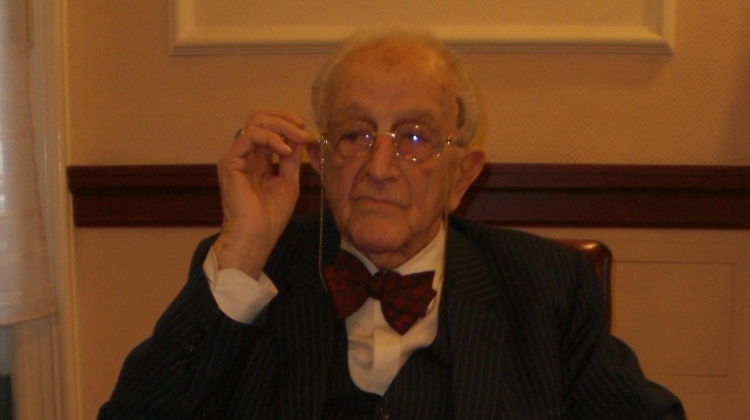
Dr. György Bárándy is one of the most distinguished lawyers in Hungary. Born in 1919, his family made a living from agricultural activities on their land in the vicinity of Törökszentmiklós, in the Northern Great Plain region of central Hungary. He completed his legal studies in the Collegium Juridicum, Foglarianum in Eger, and obtained his doctoral degree in Kolozsvár (Cluj-Napoca).
Dr. Bárándy started work as trainee lawyer in Törökszentmiklós, he also gained experience as a trainee in Budapest and in Kolozsvár. In 1951 he was arrested by the ÁVH (State Protection Authority), and interned in Kistarcsa. Freed in 1953, he was only allowed to work as an unskilled worker, hauling potato sacks in a market.
After 1956 he was able to continue his work as a lawyer, and over the last fifty years he has established a formidable record of success, and probably the best known legal practice in Hungary. In this exclusive for XpatLoop.com Dr. Judit Szegö quizzed the sharp mind of a busy man with nine decades of life experience under his belt.
How do you keep so active?
All my life I have engaged in sports, even today I spend an hour exercising, every day I do some light gymnastics or weights.
Which books have you read over the years that are closest to your heart?
I very much like the literature of Thomas Mann (1875-1955) and Stefan Zweig (1881-1942). Their approach to morality is the same as mine, and perhaps that is why I enjoy their books so much. I most certainly have favourites in Hungarian literature as well, like Zsigmond Móricz (1879-1942) and Sándor Márai (1900-1989).
What type of music do you like listening to for pleasure?
Classical music, particulary the composers Verdi (1813-1901), Rossini (1792-1868), and even sometimes Wagner (1813-1883). Also, Hungarian operetta is close to my heart, mainly the works of Imre Kálmán (1882-1953), and Ferenc Lehár (1870-1948)).
What stages of your career would you choose to highlight?
I took my secondary school leaving exam in 1937, and in the same year I enrolled in law school. On February 1, 1941 the law degree was conferred on me, and on March 1 of that year I began work as a trainee lawyer. Then came World War II, so actually I only fully became a lawyer in 1947. In 1951 I was interned to Kistarcsa for 2 years, but since I was not allowed to work as a lawyer, I had to do physical work in the Budapest Nagycsarnok (Grand Market Hall). It was on 13 October 1956 that I got back to the Chamber of Lawyers, where I have been working ever since without any retirement.
How do feel about your internment during the Communist era?
I am of the opinion that we should remember only the pleasant things in life. In addition, if somebody got into the 'limelight' back then, they could be happy to have not been executed.
You have been a successful lawyer ever since, any secrets behind your success?
I have always done my best to achieve the most favourable results for my clients given the prevailing legal framework of the day. I should say that I was lucky. When I restarted my career in 1956 I did not have a single client, but as a court-appointed lawyer I received a few cases of national importance, cases that potentially carried the death penalty, and several of my clients were acquitted.
In those days the police often used coercive measures against suspects during the investigation, therefore the testimony that the suspects gave in the investigative phase was often different from their testimony at court. I did my best to highlight these contradictions for the court. On other occasions, I used logical inference, drew the appropriate conclusions from the available facts and evidence, and thus achieved acquittal. The news of such success spread quickly around the profession.
During your career the law system has changed a lot, what have been the most important developments?
Certainly as regards political crime, there has been a complete change. There are certain human behaviours which were listed as crimes under socialism, whereas today they are not crimes, and these days they may even be considered as laudable. By way of example, I can mention financial speculation, and can add a practical example: if under socialism somebody bought the sour cherry stones from the canned food factories, and planted them and later sold the trees, they could face 3 years in prison. Today we would describe the same person as a smart businessman.
What criteria do you use to select cases?
I either take a case because it is financially rewarding, or because I find it interesting from a legal point of view, something to be resolved. In the latter case money is not an issue, and sometimes I do not do it for a fee.
Do you represent many foreigners?
I speak German and French, and under socialism almost all European embassies made approaches and asked me to represent their citizens with legal issues in Hungary.
Would you say that there is any discrimination against foreigners in judicial matters here?
Certainly there is no official discrimination. But even if judges do not verbalize it, their sentences give them away in terms of their attitude towards foreigners or even, for that matter, local minorities. But let me emphasise, it does not mean that judges intentionally make unfavourable decisions.
What about the ratio of men and women judges in Hungary, is it true that women are in the majority?
Yes, it is indeed the case. This is from an old fault within the justice system, certainly not because women would be more or less suitable for such a career. Also I must say they are underpaid and overburdened.
What is your advice for a foreigner who is falsely accused of committing a crime in Hungary?
The first and most important step is that he should hire a lawyer. In compliance with the current law in force the embassy shall be notified if proceedings are initiated against a foreign citizen, and the embassies can recommend trusted lawyers with the relevant experience. My advice is that one of these lawyers should be retained. It is a frequent problem that foreigners choose a lawyer who specialises in business and company law, but if they get involved in a criminal case they should give due consideration to hiring a lawyer with extensive experience in that area of law.
Why do think the requirement of equal treatment for foreigners in Hungary is important?
This should only be natural. Laws are not only made for the Hungarian population, there are no cases when a law should be interpreted differently for foreign citizens.
Having lived through the Nazi era, what do you think about the spreading of the extreme right views in Hungary, even in the educated clases, and about increasing xenophobia?
I do not sympathise with their views at all, neither from a political, nor from a moral point of view. The biggest problem in Hungary is that the different views and their clashes generate anxiety. And like it or not, public security is only a reality in dictatorships in Hungary or abroad. In a dictatorial system it was easy to maintain public security and order. It has always been a struggle between an existing and a desired system, and the objective of the people has been to live safely and in order.
Despite the fact I have stressed above, I do not agree with the ideology of the extreme right tendencies. I understand those citizens who would identify calm, safety and stability with the victory of these political forces. The capitalist system has failed to ensure these completely, and therefore greater stringency may well be required. Therefore I would recommend greater vigilance for the agencies who are in charge of ensuring public security. I am saying all this despite the fact that I am in favour of the capitalist system.
As your son and grandson have followed in your footsteps, please tell us a few words about their careers too.
I am very proud of my son. He is not only a lawyer because a few years ago he was also minister of justice. My grandson, though he has a law degree, has chosen politics as his career and is a Socialist MP now. I would have preferred if he had continued with our multi-generational legal practice, but this is his choice.
Do you work on cases together with your son?
Normally not, but it happens on rare occasions. There are no cases for which we would fight with each other. But we do tend to argue with each other. For example, my son is against capital punishment, whereas I am for it. Also, I do not look for justice because that's difficult to define, I tend to confine my judgments to issues of law within jurisprudence, the theory and philosophy of law, since I know what that is.
Hungarian courts have been known to hand down some dubious verdicts, what do you think about such cases?
A conscientious judge always has doubts. There is a related case in point which makes you feel some concern. Dr. Andor Fábry, who had been a military judge since World War I, approached me after his retirement and asked me to sit with him in reviewing 30 cases in which he sentenced people to death. He has ever since felt uneasy and wonders if he made the proper judgments.
Capital punishment can provide a strong deterrent against certain crimes, but innocent people may be executed, how do you feel about that?
In all states there is a constant fight between law-abiding citizens and criminals. And just like all fights, this fight has victims too. Despite this I can say that during my career I have not met a single case where an innocent person was executed, apart from in political trials. As I do not profess to know what justice always is, I do not know whether capital punishment serves it or not, it is only my personal opinion.
Finally, do you have a personal motto that you would share with us?
Indeed, my personal motto - my general motivation and intention - has to do mainly with the Civil Code, but it is a big truth: Even the worst agreement is better than winning a civil law case. If the two parties who managed to come to a settlement meet in the street years later, they will surely greet each other, and perhaps will have a coffee and chat too. In the opposite case this is almost unthinkable.
____________________________________________________________________________________________
This interview was conducted in Hungarian, it was transcribed by Dr. Judit Szego, and has been translated by Dr. József Hruby, founder and co-owner of Superfect Communications - a Budapest-based company specialised in translation, interpreting and language teaching. Superfect has been providing language services to the Hungarian Ministry of Foreign Affairs for the past 9 years.