














Video: Hungary Celebrates Easter With Special Sprinkling Tradition
- 31 Mar 2024 12:26 PM
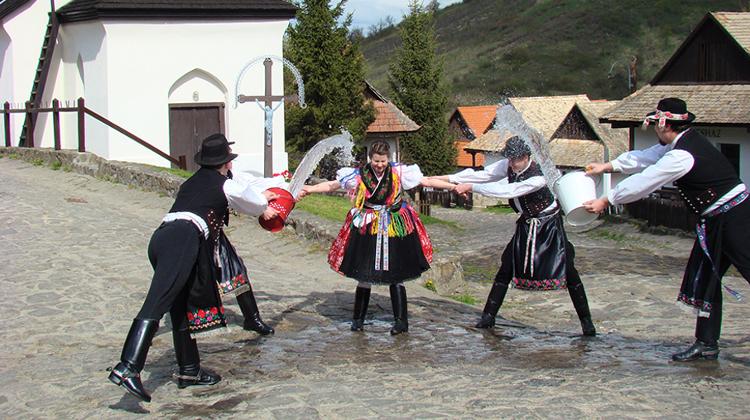
Each year a special Easter tradition takes place around Hungary, as is always witnessed by many in a small village located in north-eastern Hungary. Visitors beware: you may get wet, as the video below shows.
Declared a UNESCO World Heritage Site in 1987, for three days Hollókő becomes a tourist magnet at Easter time.
Getting wet then has nothing to do with the weather, because the tradition is for boys and men to sprinkle / throw water over young ladies, for which the girls actually reward them with small gifts.
“Easter sprinkling” (húsvéti locsolkodás) is based on a local belief in the cleansing power of water, and it is connected to a fertility rite.
So Easter Monday in Hungary is also called “Dousing Monday” (vízbevető hétfő), because men go around town drenching the girls with buckets of water - traditionally freshly drawn from the well.
More recently, the buckets of water are usually replaced with scented water or perfume, and the sprinkling is accompanied by the recital of an Easter Rhyme.
The custom varies, of course, from region to region, and is more traditional in the small villages. Eastrer Rhymes can also be quite elaborate or short and funny. A sample of these follows, in the translation of Iren Bencze:
Ajtó mögött állok,
Piros tojást várok.
Ha nem adtok, lányok,
Estig is itt állok!
Here I stand behind the door,
My Easter egg I’m asking for.
Ladies, better mark my word,
Bring my egg or here I mold.
***
Ákom-bákom, berkenye,
Szagos húsvét reggele.
Leöntjük a virágot,
Visszük már a kalácsot.
Scribble-scrabble, Service Tree,
Easter Monday, fragrant glee.
Pretty flowers water we,
With cookie bounty out we flee.
Along the Ipoly River, boys used to go to girls’ homes on the evening of Easter Sunday, collect fresh eggs from them, and make scrambled eggs the next day. They would scatter the broken shells under the window of the girl they were cross with. That taken care of, they would then proceed with the sprinkling. The girls would try to hide, but whoever was found could not escape the bucket of cold water.
Throughout the country, the reward for sprinkling is a treat with food or drinks, and of course, the Easter egg (hímes tojás). The Easter egg can be plain red or intricately decorated. Before the appearance of modern dyes, natural ingredients were used to color the eggs. One of the most common ways to tan the eggs is to boil them with onion skin.
There are many other decorating techniques, one of the most interesting ones being candle dripping. The warm wax was applied with a feather quill attached to a glass, tin, or earthenware container. The design drawn with the wax would remain white after the dyeing process.
Another simple technique that yields an intricate design is attaching damp leaves to the eggs, before boiling them with onion skin or using other dyes. When the leaves are removed from the air-dried eggs, their shape and veins remain outlined on the colored eggs.
Source: EuroNews / Puszta.com





LATEST NEWS IN community & culture