














An Englishwoman's Life in Communist Hungary': Book Two, Chapter 7, Part 1
- 5 May 2025 6:23 AM

Marion Merrick’s books are the only first-hand account written by a westerner of what it was like to live and work in communist Hungary, and then in the aftermath of the 1989 change of regime.
Now You See It, Now You Don’t and House of Cards have been included as part of the Open Society Archive dedicated to this period in the CEU. You can read a serialisation of them here on Xpatloop. You can also buy the dual-volume book on Kindle as well as in Stanfords London.
Book Two, Chapter 7, part 1
The summer holiday was spent in England as planned. It was undoubtedly beneficial for the children to be immersed in the English language again when an ever-increasing proportion of their time was being taken up with Hungarian schoolwork.
One of our stays was in London with Danielle. After the failure of her attempt to persuade Nick that marriage was the logical step to follow their eight years of cohabitation, she had married Jonathan and now had two young children.
They lived in Finchley where Danielle continued to teach the piano and pursue her various other interests, but she regularly saw Nick. Their bond had not been broken by the mere fact of living separately, and their shared musical enthusiasms and mutual respect resulted in them going to concerts and the opera together just as they had done ever since they had first met.
‘Is Nick in Hungary at the moment?’ I asked, as we sat down in the comfortable Victorian sitting room to our first cups of tea.
‘No,’ replied Danielle. ‘I didn’t want to tell you on the phone, but Nick’s been very ill. In fact, he’s in hospital at the moment having tests.’
‘What’s wrong with him?’ asked Paul.
‘We don’t know, but he can’t eat, he’s just been getting thinner and thinner, and you know he wasn’t exactly fat to begin with.’
‘Yes, I thought he looked thin when he was with us at Easter,’ I said. ‘But we just thought it was the way he lived, not eating properly, not looking after himself.’
‘At first they said it was a stomach ulcer, but now they say it isn’t. I don’t see him going to Hungary this summer.’
When we returned to Budapest in September we were telephoned by Tom and Donát in Baja. They were perplexed not to have heard anything from Nick, and did not have Danielle’s phone number.
‘What’s wrong with him?’ they asked.
‘I don’t know,’ I said, ‘but he can’t eat and he’s lost a lot of weight.’
‘Yes, we noticed that at Easter, and he didn’t drink anything either. Well, you know he’s no alcoholic, but he’s always enjoyed wine and a glass or two of pálinka. But he didn’t touch a drop. We thought it was strange.’
Danielle telephoned a few days later.
‘Nick’s been diagnosed as having cancer of the pancreas,’ she said quietly. ‘I went to see him in hospital and he looks dreadful, but he wouldn’t stay there, he’s discharged himself.
The problem is that no-one, not one of his friends, knows where he lives – I can imagine it’s a virtual slum, which is why he won’t tell anyone – so I can’t go and see if he’s all right. The hospital said they couldn’t release his address but that a Macmillan nurse will be going there regularly.’
We relayed the information to the friends in Baja.
A few weeks later, in early October, Danielle rang again.
‘Nick’s in a hospice now,’ she told us. ‘He was in too much pain to be at home alone and he agreed to go. I’ve been in to see him, it’s terrible, he’s almost unrecognisable. He keeps on talking about coming to Hungary when he’s better, but when I went last night I think it had dawned on him that he’s not going to recover. He was quite depressed, but then he asked me if I would arrange a memorial concert for him and he really cheered up choosing all his favourite music.’
Then a few days later came the inevitable news.
‘Nick died this morning,’ said Danielle. ‘You won’t believe it, but he was playing chess last night with his friend Alan. He seemed quite cheerful. I’m going to organise the memorial concert for next month – I know you won’t be able to come, but Paul, you could write a piece for him if you like. And I want to put this idea to you, too: Nick has no relatives and as you know, if things had worked out according to plan, he would have left England in a year or two and come to live in Hungary.
He’s going to be cremated – that’s what he wrote in his will – but he didn’t say anything about what we should do with the ashes, and I couldn’t bring myself to ask him. I just feel there’s no point in scattering them here in London, you know he hated living here; he only came because of me.
So I’ve been thinking that he should be buried in Dunafalva, maybe in the garden of his house. You don’t have to tell me now, think about it and let me know – perhaps talk to the people in Baja, and ask Attila what he thinks.’
We made a list of everyone who had known Nick and rang them with the news. Miklós decided we should all get together to discuss the idea of bringing Nick’s ashes to Hungary and burying them in Dunafalva.
Tom and Donát suggested we meet in Baja, since it was now also necessary to decide what was to be done with Nick’s house, and as yet none of us had even seen it. Danielle had spoken to Tom in the interim and told him that Nick’s wish was that the house be used by any of his friends in Hungary who might wish to go there.
Attila’s car was off the road and so we picked him up at his house in Zsámbék. Large-scale renovation work was underway, as he was having various outbuildings, originally stables, incorporated into the main part of the house.
‘Come in! Come in!’ called Attila, opening the huge wooden doors that led into the yard, with a key some ten inches long, fit to open castle gates. ‘Everything’s a mess as usual! You know I’m having building work done, but come in and have a cup of tea.’
I was anxious to get started on the long drive to Baja, but both Paul and Attila – in common with so many English people – shared an almost religious veneration for the universal efficacy of tea in all circumstances, and I knew there was no escape.
The whole area of the original small peasant house, which Attila had bought from an alcoholic woman some years previously, was now a huge kitchen with a small bathroom leading off it in the far corner. Spiral stairs led up to bedrooms, bathroom and a study above, and from here it would soon be possible to enter the stable area.
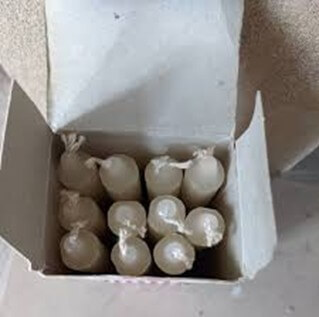
As Attila made tea we sat at the large kitchen table. In front of me was a shabby cardboard box of candles with German writing on it. Attila observed me looking at it.
‘Guess where that comes from,’ he said, smiling.
‘Germany, I suppose. Maybe East Germany?’ I guessed, judging by the dull brown card and the general old-fashioned packaging.
‘No, Austria,’ said Attila. ‘But from 1973. Didn’t I ever tell you about that?’ he chuckled.
‘No.’
‘Do you remember the coal strikes in England, and then the electricity cuts every day?’
‘Yes, I remember, three times a day for three hours, no electricity. I was at school and it was a great excuse not to have to do our homework.’
‘Well, I was living in London then, and you must also remember that within a few days you couldn’t buy candles either, they were all sold out. So a friend and I had the idea to import a lorry load of candles from Austria and sell them in England. My share was six hundred kilos and I put most of my savings into it. And then guess what happened?’
Attila started to laugh. ‘The lorry arrived on the very day that the strike ended! We were stuck with a couple of tons of candles!’
‘What on earth did you do with them?’ Paul asked.
‘Well, my flat had just one small bedroom, so I had to move my bed out of there and sleep in the sitting room, and the bedroom was filled with boxes from floor to ceiling. Then, whenever I went to visit anyone, instead of taking flowers or a bottle of wine I took a couple of boxes of candles.’
‘So how did they get here, then?’ I asked him.
‘Well, last week an old friend of mine was here from England. I’d forgotten, but apparently I’d taken him lots of boxes of candles on my various visits and he still had them – so he brought me some as a present!’
We laughed. Attila had done well out of his smuggling activities in the 80s, when he regularly drove to and fro between London and Budapest, bringing all sorts of goods then unavailable, but this had obviously been one of his less successful ventures.
By the time we reached Tom’s house in a quiet street in Baja, Miklós, János and Donát were already there. We began by discussing the idea of burying Nick’s ashes in Dunafalva.
‘It’s all right,’ said Donát, ‘but I don’t think he should be buried in the garden. Of course, you haven’t seen the house yet, we’ll take you there tomorrow. But who knows what’s going to happen there long term?’
‘Danielle rang me and said we should keep it as a holiday home,’ said Tom. ‘It’s a good idea, but I’ll be absolutely honest with you – the house is uninhabitable, the floors are just earth and there’s no bathroom. I can’t afford to renovate it – I haven’t even been able to finish doing this house.’ He waved his hand towards the window and the small cement mixer sitting idle on a pile of sand in the garden.
The discussion continued until Attila asked, ‘Isn’t there anywhere else in Dunafalva? Isn’t there a cemetery there?’
‘Well, there’s a Catholic church and that has a small graveyard. Nick wasn’t Catholic, was he?’
‘Actually, he was,’ replied Paul. ‘Maybe not a practising one, but he came from a Catholic family.’
‘Well, we could try that,’ said Tom, ‘though I don’t know how we go about getting permission. But I can ask the local priest there.’
‘But how are we going to get his ashes from London?’ asked Miklós. Silence.
‘We can hardly ask Danielle to post them,’ said János. We all smiled, knowing how Nick would appreciate such black humour.
‘I could drive over and get them as soon as my car’s back on the road,’ Attila offered.
Click here for earlier extracts


LATEST NEWS IN community & culture