











Quantum-Optical Devices for Next-Gen Info Transfer Developed by University in Hungary
- 20 Apr 2026 1:07 PM
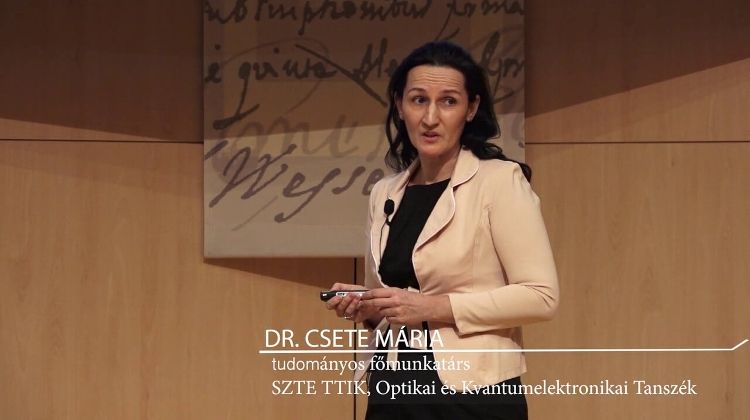
Researchers at the University of Szeged (SZTE) are developing novel quantum-optical devices using metamaterials to revolutionise information transfer, the university's communications office said in a press release on Friday. The project, led by Dr Maria Csete, is part of an international collaboration.
Current optical and laser technologies face key limitations such as light amplification, control, and detection are restricted by physical constraints.
Other challenges include molecular-sized fluorescent light sources critical for quantum applications are either unstable or hard to control for single-photon information encoding, the press release said.
Also, conventional detectors cannot capture the unique properties of single photons and as yet missing components hinder the development of fast, stable, light-based computing systems.
However, metamaterials, which are artificially engineered structures with patterns smaller than the wavelength of light, bend the rules of classical optics. Unlike natural materials, they can exhibit properties like negative refractive indices, enabling unprecedented control over light.
Their behaviour can be mathematically modelled or simulated for complex structures, allowing researchers to enhance and combine properties to create entirely new functionalities, as well as manipulate light in ways previously impossible, such as precise control over intensity, spatial distribution, and polarisation.
SZTE team's method uses computer simulations to integrate light sources, detectors, and metamaterials into a single, optimised system, and this approach could lead to faster, more efficient, and reliable quantum information systems.
While the project is fundamental research, its long-term applications could transform daily life by paving the way to unhackable communication as quantum information transfer enables practically eavesdrop-proof data transmission.
It could also lead to advanced diagnostics and environmental sensors, with more precise, miniaturised tools for health care and ecology.
Next-generation computing could also be unleashed as metamaterial-based components replace silicon chips, shifting information technology from semiconductors to light-based systems.
The 1 million euro-funded project, supported by the Hu-Rizont grant**, involves experts from Harvard University, Ulm University, KTH Royal Institute of Technology (Sweden), the Foundation for Research and Technology-Hellas (Greece), and Georgia Southern University.
Photo: youtube screenshot
Source: MTI – Hungary’s national news agency since 1881. While MTI articles are usually factual, some may contain political bias, and readers should be aware that such content does not reflect the position of XpatLoop, which is neutral and independent.
Since the goal of XpatLoop is to keep readers well briefed, right across the spectrum of opinions, MTI items are shared to ensure readers are aware of all narratives within the local media.
XpatLoop believes in empowering readers to form their own views through complete and comprehensive coverage. To facilitate this XpatLoop has a balanced range of news partners, as you can see when you surf around XpatLoop.com
*********************************************************************************************
You're very welcome to comment, discuss and enjoy more stories via our Facebook page:
Facebook.com/XpatLoopNews + via XpatLoop’s groups: Budapest Expats / Expats Hungary
You can subscribe to our newsletter here: XpatLoop.com/Newsletters
Showcase Your Business to Expats in the Loop:
As an independent portal we’re grateful to all commercial supporters who help keep you in the loop with fresh insights and inspiration. Do you want your business to reach tens of thousands of potential high-value expat customers? If so please contact us here.


LATEST NEWS IN tech