
















TI: Hungary Remains Most Corrupt EU Member State for 4th Consecutive Year
- 11 Feb 2026 3:36 PM
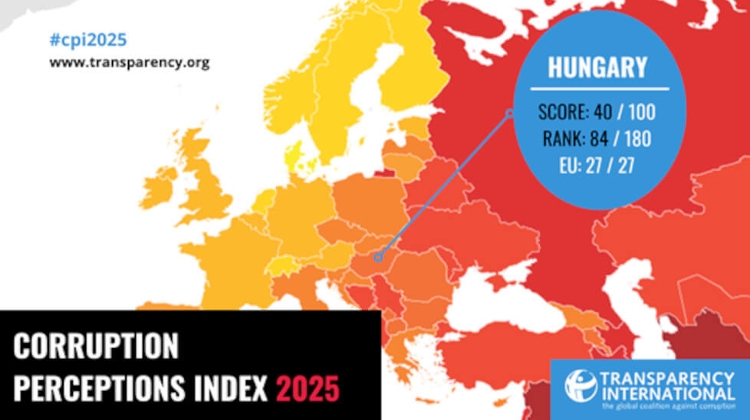
In 2025, Hungary was once again ranked at the bottom of the European Union, sharing last place with Bulgaria this time, according to the annual Corruption Perceptions Index (CPI) compiled by the Secretariat of Transparency International in Berlin.
Compared to its 2024 result, Hungary lost one point and fell from 82nd to 84th place in the global ranking, with a score of 40 points. This is the worst score and the lowest ranking Hungary has ever recorded in the CPI.
The poor result reflects the continued failure to remedy rule of law deficiencies and to curb systemic corruption, according to the report by Transparency International Hungary, presented together with the CPI results in Budapest on the 10th of February.
Systemic corruption, manifested in the organized theft of public funds, is the main reason behind the country’s now persistent economic decline.
This year, the Secretariat of Transparency International in Berlin has published the Corruption Perceptions Index for the 31st time, ranking countries based on their resilience against corruption in the public sector. Ranked among 182 countries, Hungary scored 40 points and dropped to 84th place, achieving its worst result to date.
Within the European Union, Hungary again ranked last in 2025, this time tied with Bulgaria. Hungary has recorded the most significant decline among EU Member States over the past thirteen years: between 2012 and 2025, its score measuring resilience against corruption fell by 15 points.
Meanwhile, the Baltic states have shown substantial long-term improvement in CPI performance. Estonia has been a regional champion for a long time and in 2025, it ranked first in the region by a wide margin.
The gap between the region’s top performer (Estonia) and the last-ranked countries (Hungary and Bulgaria) has continued to widen and now stands at 36 points. Lithuania ranked second in the region with 65 points, ahead of Latvia with 60 points.
The three Baltic states have therefore been notably successful in combating corruption; this is reflected in the fact that their CPI scores exceed not only those of the Eastern European EU member states, but also those of all Southern European EU countries.
Increasing differences can also be observed within the Visegrád Group. The performance of the Czech Republic, which scored 59 points, has improved significantly: compared to 2012, its result in 2025 was 10 points higher.
Poland’s position has stabilized following the 2023 change of government. In contrast, Slovakia’s corruption index has shown a declining trend over the past two years, which may be linked to the 2023 change of government that brought back into power a government disregarding rule of law norms.
Although government propaganda in Hungary repeatedly attempts to suggest otherwise, not only Transparency International’s Corruption Perceptions Index, but all other relevant and reliable analyses —including Eurobarometer surveys and the World Bank’s governance indicators — confirm that corruption in Hungary remains severe. In regional and EU comparison, Hungary continues to rank among the most corrupt countries.
“Corruption is not inevitable: those in power must be held accountable in the public interest in order for democracy to function and for us to live in a free and open society,” said François Valérian, the global president of Transparency International in connection with the publication of the CPI’s global results.
Rule of law: no turning point despite EU pressure
Alongside the publication of the CPI results, Transparency International Hungary has released a comprehensive study on the state of corruption in Hungary. The report concludes that in recent years the European Union has attempted to strengthen and restore the rule of law in Hungary through several instruments.
The most important among these is the conditionality mechanism launched in 2022. As part of this process, 27 rule-of-law and anti-corruption conditions (milestones and super milestones) have been imposed, which the Hungarian government is required to fulfil to gain access to large amounts of currently suspended EU funding.
After more than three years, it has become clear that the proposed reforms have not been able to break systemic corruption or restore the rule of law. This is partly because the government’s centrally orchestrated system of channelling public money into private pockets (known as the National System of Cooperation, or NER in Hungarian) is incompatible with the rule of law.
The Hungarian government is only interested in legal solutions that do not endanger the preservation of its power. Another problem is that some of the conditions would not achieve their intended purpose even if formally fulfilled — that is, they would still not be sufficient to cleanse the country of systemic corruption.
The report by Transparency International Hungary examines the fulfilment of the most important rule of law and anti-corruption requirements. Each requirement was assessed in terms of its impact. The analysis shows that some requirements cannot break systemic corruption, while the implementation of others is simply being sabotaged by the government.
Transparency International Hungary has also analysed the recommendations included in the EU rule of law reports and concludes that the government does not protect whistleblowers, does not prosecute high-level corruption, and does not guarantee fair party and campaign financing leading to the entanglement of party and state.
Another year of impunity – Hungary’s most serious corruption cases in 2025
The report by Transparency International Hungary illustrates the practical consequences of systemic corruption through three high-profile cases that received the most public attention in 2025. The most striking example of the impunity of high-level corruption is the scandal involving the Hungarian National Bank (MNB).
Through a web of foundations and private equity funds, at least HUF 270 billion in public money was stolen, while the fate of roughly the same amount remains uncertain. To date, no one has been held accountable.
Although the investigation has been ongoing for a year, no cronies and family members of György Matolcsy, the former MNB governor, have been named as suspects.
Another recent milestone in the crony privatization of public assets is reflected in the transfer of state-owned defence industry interests valued at HUF 72 billion to a subsidiary of 4iG, a company favoured by the NER, without a competitive tender. The report also mentions the Hatvanpuszta manor project, which serves as evidence of Prime Minister Viktor Orbán’s personal enrichment.
Public procurement and private equity funds
Although several milestones under the conditionality mechanism are aimed to address deficiencies in Hungary’s public procurement system, the sector — representing 5.3% of GDP in 2025 — remains a hotbed of corruption.
Despite a slight decline in the share of single-bid tenders, the highest-value contracts continue to be awarded to actors close to the government, including companies linked to Lőrinc Mészáros and László Szíjj.
The widespread use of framework agreements further damages the perception of public procurement: in 2024, framework agreements worth HUF 3,219 billion were concluded. Moreover, in more than two-thirds of cases these contracts were concluded in a competition-restricting manner, with only one market actor.
Competition in the public procurement market is also undermined by opaque investment structures deliberately and systematically used, such as private equity funds.
As noted in Transparency International Hungary’s study published at the end of last year, the identity of ultimate investors in private equity funds remains concealed.
For this reason, the EU has launched an infringement procedure against Hungary. Private equity funds are being inflated through various channels of state capital injections: by the end of 2024, the Hungarian state had invested HUF 1,311 billion in private equity funds without transparency or accountability safeguards.
According to Transparency International Hungary, this practice is contrary to Hungary’s Fundamental Law.
Economic decline driven by corruption and the dismantling of the rule of law
Hungary has by now become one of the poorest member states of the European Union. The turbulent post-Covid period revealed that the Hungarian economy is far more vulnerable than those of its competitors. Hungary’s economy has stagnated for three years; across most economic indicators, Hungary has become the weakest performer in the EU.
“The main reason for Hungary’s poor economic performance is an autocratic government that has subordinated its economic policy to systemic corruption and the organized theft of public funds, undermining fair competition,” said József Péter Martin, Executive Director of Transparency International Hungary, at the presentation of the report.
The government has undoubtedly achieved results in reducing petty corruption but has used organized corruption as a tool to entrench its power and enrich NER-linked actors.
To this end, it has channelled several trillion forints of public money — directly or indirectly — to NER-linked economic actors, severely distorting market conditions.
The only way out of the vicious circle of systemic corruption and weak economic performance would be the restoration of the rule of law, which is inconceivable within the framework of the current political regime.
EU funds: further irreversible loss of resources
In 2025, due to rule of law deficiencies, Hungary permanently lost an additional EUR 1.1 billion from the EU cohesion policy financial framework allocated to the country for the 2021–2027 period. As a result, Hungary’s cohesion funding envelope set until 2027 decreased from EUR 21.7 billion to EUR 19.6 billion, after subtracting the funding losses incurred in 2024 and 2025.
A similar risk can be seen regarding the fund created after the Covid pandemic, known as the Recovery and Resilience Facility (RRF). If the Hungarian government fails to fully implement the 27 anti-corruption and rule of law restoration measures it committed to under the RRF Plan by the end of 2026, Hungary may lose the entire RRF envelope.
Hungary’s EU financial balance is further worsened by a judgment of the Court of Justice of the European Union dated 13 June 2024, which ordered the government to pay a lumpsum fine of EUR 200 million, as well as a coercive penalty of EUR 1 million per day. The reason for this ruling is that the government has consistently failed to implement an earlier European court judgment concerning asylum law.
About the Corruption Perceptions Index
The Corruption Perceptions Index is compiled by Transparency International’s Secretariat in Berlin using 13 surveys and assessments conducted by 12 organizations.
The measurement tools underlying the CPI determine the level of corruption in the public sector of each country based on the evaluations of businesspeople and experts. In 2025, sufficient data were available for 182 countries; Hungary was assessed on the basis of 10 different sub-indices.
The CPI is a composite indicator: when compiling it, researchers at Transparency International’s Secretariat in Berlin project the scores of the background indices onto a scale from 0 to 100 and calculate each country’s CPI score as the average of the sub-index scores.
In the CPI, “0” indicates the country most affected by corruption, while “100” indicates the least affected.
A detailed description of the CPI methodology is available on Transparency International’s website.
The CPI was created in 1995. In 2017, Transparency International requested a credibility test from the European Commission; the audit conducted by the Joint Research Centre (JRC) found the CPI to be a suitable tool for measuring corruption.
The JRC concluded that the CPI is conceptually and statistically coherent and well-balanced, meaning that no single data source dominates the index.
Source:
Transparency International
*********************************************************************************************
You're very welcome to comment, discuss and enjoy more stories via our Facebook page:
Facebook.com/XpatLoopNews + via XpatLoop’s groups: Budapest Expats / Expats Hungary
You can subscribe to our newsletter here: XpatLoop.com/Newsletters
Showcase Your Business to Expats in the Loop:
As an independent portal we’re grateful to all commercial supporters who help keep you in the loop with fresh insights and inspiration. Do you want your business to reach tens of thousands of potential high-value expat customers? If so please contact us here.


LATEST NEWS IN current affairs