














Palaces & Aristocratic Residences In Hungary
- 8 Jul 2011 9:04 AM

The magnificent aristocratic residences were not only the venues of candlelight dinners, ballroom dances and stolen kisses, but they were also functioned as political and economic centres. Today, the most beautiful Hungarian palaces await admirers of all romantic ages with various cultural programmes and events.
Festetics Palace is one of the largest Baroque aristocratic residences in Hungary. It is located in Keszthely, a town on the shore of Lake Balaton. Its construction started in 1745; since then it has been rebuilt several times.

With its 101 rooms, the palace today serves as a museum and hosts cultural events. It displays the past luxurious life of aristocrats, as well as the furniture, library and a treasure of rare books which have been preserved in their original state.
The name of the most illustrious member of the family, Count György Festetics (1755–1819), is associated with the publication of several Hungarian literacy works and periodicals; and as a known supporter of Hungarian literature, he also provided patronage to many writers and poets.
With trees as old as 400 years, the 42 hectares of French and English gardens surrounding the palace serve as an excellent venue for open-air theatre performances. The palace museum enchants evening visitors with candlelight tours.
Esterházy Palace is located in Fertőd, a town in Northeast Hungary. Construction began in 1720 and continued into the second half of the 18th century. It’d designs were based on the plans of Prince Nikolaus Esterházy (“the Magnificent”).
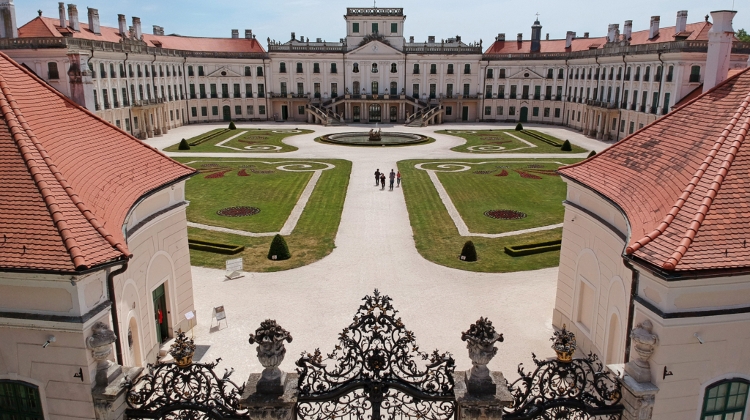
The complex is often called “the Hungarian Versailles” and is viewed as a worthy partner to Schönbrunn Palace, in Vienna. Originally, a 20 room hunting lodge, the palace saw its zenith during the reign of Nikolaus Esterházy II (1765–1833).
The prince was especially fond of luxury, so his court was also characterised as sumptuous. He expanded the palace to 126 rooms and furnished them with contemporary furniture and fantastic interior ornaments, which has astounded generations even to this day.
The family’s hunger for music was satisfied by the prominent composer of the period, Joseph Haydn, who lived and worked in the Music House on the palace grounds for 30 years. Later, the collection of paintings of the prince’s family of connoisseurs, served as the basis of the Hungarian Gallery, which have been moved and now located in the Museum of Fine Arts.
In 1946, a horticultural secondary school and dormitory was established in one of the edifices of the building complex, which had been damaged during World War II. Today, the palace is completely renovated and stands in nearly to its original splendour. It partly functions as a museum, but its banquet hall and park also host cultural events and classical music concerts.
Located near Budapest, Gödöllő is home to Grassalkovich Palace, the favourite summer residence of Elisabeth (Sissi), Empress of Austria and Queen Consort of Hungary. Construction was started in 1740 by Count Antal Grassalkovich, a confidante of Empress Maria Theresa.

The complex of edifices reached its present form in the 19th century, during the third generation of the family, when the count ordered the construction of a church, theatre, riding arena, spa, flower house and even an orange house.
After the family was left without male heir, ownership changed several times; it was given by the Hungarian state to Franz Joseph I and his wife Elisabeth, as a coronation present. Later, it became the resort residence of the sitting Hungarian emperor.
After World War II, the building was taken over and used as a warehouse and stables by Soviet soldiers. The furnishings were either carried away or destroyed on the spot. For some time, the palace also served as a nursing home.
Renovations and evacuation started only in 1985 and 1994, respectively. Today, the palace houses a museum but also functions as a centre for cultural and other events. During the term of the Hungarian EU Presidency, it was used for most of the major meetings.
Based on the plans of the prominent Hungarian architect Miklós Ybl, the Wenckheim residence was built in the German neo-renaissance style, between 1875 and 1879 in Szabadkígyós, southeast of Hungary.
As the residence of one of the wealthiest 19th century landlords, Frigyes Wenckheim, and his wife Krisztina Wenckheim, the building was the most splendid and modern palace of the age, furnished with state-of-the-art technical equipment. At one time, the exterior of the building was illuminated by gas lighting that was supplied from the "gas house".
The palace's large English garden was created at the same time as the residence. A French baroque garden was designed in front of the main façade, while an English landscape garden was created farther from the building. The park also features a swimming pool, a tennis court and a runway for sports aircraft.
The last count to live here was József Wenckheim and his family, who abandoned it in 1944, and fled to Vienna because of the war. After World War II, the building was nationalised and a specialised school for agriculture and food industry was established in it. Now, the palace houses the János Harruckern Public Education Institute, which can be visited subject to pre-arrangement.
One of the largest baroque palaces in Hungary is located in Edelény, northeast of Hungary. It was constructed for François Jean L’Huillier, a nobleman from Alsace-Lorraine and a commander of the Eger Castle who fought against the Ottoman Empire and took part in the recapture of the Buda Castle.
According to engravings on the palace façade, the building was completed in 1730; however, the names of the architect and the master builder remain unknown. The most precious part of the palace is made up of the six rooms on the upper floor, which were decorated with beautiful rococo mural paintings.
After the death of the last heir, the estate passed to the Hungarian Royal Chamber, which was responsible for the economic and financial administration of the country. In 1836, the estate was purchased as a financial investment by Prince Ferdinand of the House of Saxe-Coburg and Gotha, and the country’s largest sugar refinery was established here in 1838; however, the owners chose to later lease the estate during the middle of the century, and it soon fell into decay.
The former farm buildings were destroyed and the English garden was left uncultivated. By 1909, the palace had deteriorated to the extent that it called for a full-scale restoration.
Today, the Palace of Edelény is under the administration of The National Trust of Monuments for Hungary, which began the restoration work in autumn 2009. The renovated castle now houses a museum and several event halls.
Since 2012, the building offers visitors various exciting touristic, family and cultural programmes.
*********************************
You're very welcome to comment, discuss and enjoy more stories via our Facebook page:
Facebook.com/XpatLoopNews + via XpatLoop’s groups: Budapest Expats / Expats Hungary
You can subscribe to our newsletter here: XpatLoop.com/Newsletters
Showcase Your Business to Expats in the Loop:
As an independent portal we’re grateful to all commercial supporters who help keep you in the loop with fresh insights and inspiration. Do you want your business to reach tens of thousands of potential high-value expat customers? If so please contact us here.

LATEST NEWS IN getting around