


















Special William Blake Exhibition at Budapest's Fine Arts Museum
- 25 Sep 2025 7:31 AM
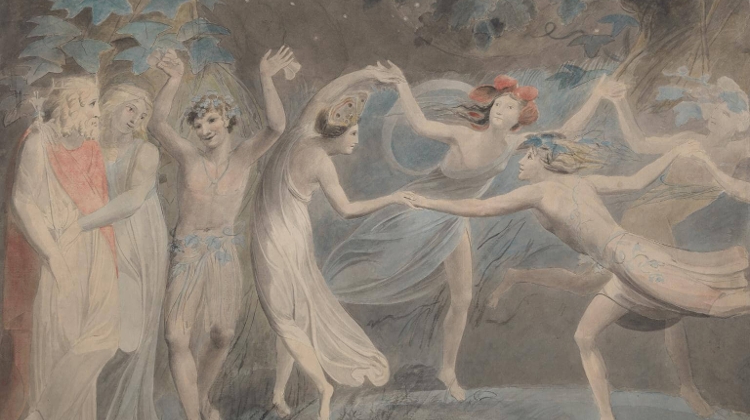
On display until 11 January. For the first time in Hungary, an exhibition of the works of poet and painter William Blake is on show. The exhibition titled The Marriage of Heaven and Hell - William Blake and His Contemporaries is open to the public from this Friday at the magnificent Fine Arts Museum.
The exhibition is this year's outstanding cultural undertaking in Hungary, the significance of which is further enhanced by the exemplary international institutional cooperation, said the Secretary of State for Culture at the exhibition's opening in Budapest.
"Blake's vibrant, shockingly suggestive world between heaven and hell does not promise us easy entertainment, a pleasant instant adventure," said the Secretary of State.
She added that the oeuvre and its cross-section of one of the most exciting geniuses in cultural history, the virtuoso of English Romantic literature and fine arts, shows us something different.
"The present presentation of Blake's art, fused into images, visions, words and prophecies, is an invitation to a journey into the deepest depths, into a completely unique universe in which the separation of the arts, literature and fine arts, can no longer be interpreted, in which only the creator, the creation, exists in its indissoluble and inseparable unity," Závogyán pointed out.
"The cult of William Blake has affected Hungarian art in several eras, which means that both the artist and the era are timeless", emphasised Zsolt Petrányi, Deputy Director General of the Museum.
He said that Csilla Regős, one of the curators of the exhibition, tried to present this parallel in the gap-filling exhibition by starting with the works of Béla Kondor and Lőrinc Borsos, setting the tone for the exhibition, and emphasizing that this exhibition is not about the isolated art world of an isolated era, but is also able to communicate with the present through countless threads.
Ted McDonald-Toone, Tate's head of international relations, said Blake's work had inspired countless writers, poets and painters, and his legacy was reflected in modern pop culture. "He was an artist, a poet and a prophet, Blake cannot really be categorised," he said.
See Most Significant Works by Blake
Ted added that the artist's vivid, symbolic world created a universe in which the visible and the invisible, the sacred and the profane, coexisted.
"The exhibition invites the Budapest audience to enter this world and discover the turbulent period in which Blake lived, which inspired generations of artists to explore the extremes of horror and beauty in works that both harkened back to historical texts and their own imaginations," he said.
The exhibition, selected from the collection of the Tate in London, presents the most significant works of this prominent figure in British art and literature and also presents a particularly eventful period in English art.
Neglected Artist During His Lifetime
William Blake (1757-1827), a neglected artist during his lifetime, inspired generations with his visionary works, prints, watercolors, poems, and prophecies.
The exhibition, which features over a hundred works, will feature Blake's works alongside those of his most influential contemporaries and artists, including Henry Fuseli (Heinrich Füssli), Benjamin West, John Hamilton Mortimer, and JMW Turner.
William Blake, one of the most famous artists of the British Romantic period, lived in London and worked as an engraver, often working late into the night. He invented new printmaking and painting techniques to perfectly express his imagination. He saw himself as a prophet who, through his art and poetry, built a bridge between the spiritual and the tangible worlds.
Radical Political Views, Deep Religious Faith
Blake's works often drew on his radical political views, deep religious faith, and personal struggles. His unique perspective shocked and amazed many of his contemporaries, some of whom thought him mad.
The thematic sections of the large-scale exhibition, realized in collaboration with the Tate in London, are built around a key work, in which different dimensions of the artist's multifaceted imagination are outlined.
Poet Painter
In the first section, Poet Painter, the curators recall Blake's illustrated poems, the earliest of which he wrote as a child and for which he also made drawings with the encouragement of his mother. He received no formal education, was taught at home, and then copied Gothic tombs in Westminster Abbey as a young man, and during his apprenticeship he became a master of engraving.
He refined his experiments in printing techniques for the rest of his life, often returning to his early poems and making new copies from existing printing plates, and adding texts to his earlier engravings.
Terror and Danger
The changes and turmoil of the late 1700's prompted many artists to seek answers to the extremes of the world at that time.
In Blake's works on display in the exhibition section entitled Terror and Danger, this is expressed in writhing and twisting bodies, in depictions of suffering and agony. Darker themes of captivity, madness, terror, danger and disease, as well as dramatic depictions of nature, were also prevalent among his contemporaries.
Fantastic Creatures
The Fantastic Creatures section is dominated by the supernatural essence created by Blake and his contemporaries, the Romanticization of the Past section brings to life emblematic images and stories from the British past, and the Gothic space presents the relationship between the art historical era and Blake's work.
The exhibition section entitled Newton's Body focuses on one of Blake's most emblematic works, the rarely borrowed painting Newton, while the works in the exhibition section entitled Satan and the Underworld depict the coming apocalypse.
At the exhibition, visitors can also learn about Blake's influence on Hungarian artists: the curators present the literary aspects through the works of Antal Szerb and Lőrinc Szabó, and the visual arts parallels through the works of Lőrinc Borsos and Béla Kondor.
The exhibition is the fourth collaboration between the Museum of Fine Arts and the Tate in London, following the exhibitions Turner and Italy (2009), Bacon, Freud and the Painting of the London School (2018), and Desired Beauty - Pre-Raphaelite Masterpieces from the Tate Collection (2021).
The exhibition, which will be on display until January 11, 2026, is curated by Csilla Regős and Alice Insley.
More:
mfab.hu



LATEST NEWS IN entertainment