






















'Gothic Art In Hungarian Kingdom Between 1300 – 1500' Exhibition @ National Gallery Budapest
- 29 Dec 2023 4:09 PM
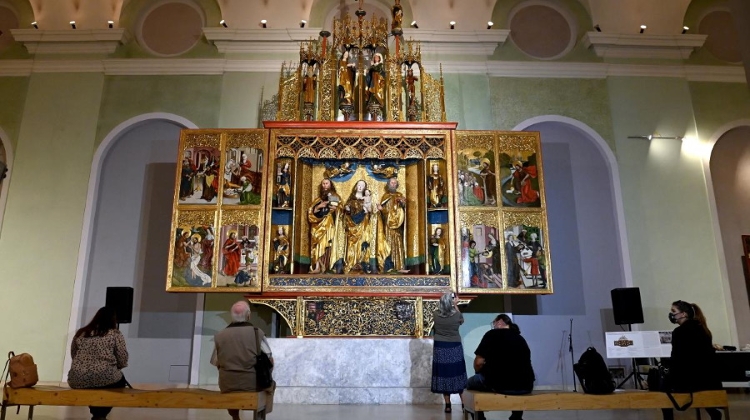
Permanent exhibition: The largest museum collection of winged altars, panel paintings and wooden sculptures from the Kingdom of Hungary.
From the Museum Team: The exhibition presents objects which originated between 1300 and 1500 – paying attention to chronology and stylistic development – bearing in mind the original places where they were made and used. As an introduction, we evoke the atmosphere of a church interior that experienced natural growth in line with changing needs and opportunities, while to close, visitors can see an ensemble of early winged altars.
Gothic panel paintings, wooden sculptures and winged altars are leftovers from the furniture used in medieval churches. Objects utilised in the Western Liturgy were made to present and convey a religious message.
Most of the panel paintings belonged to winged altars, while personal religious contemplation and private worship outside ecclesiastic ceremonies were served by smaller altars and self-standing devotional paintings that were also capable of containing relics.
The wooden sculptures in our collection are also mostly from winged altars, and their forms, their iconographies and their surface treatments all depended on the position they originally occupied as part of the altar.
Maria Gravida, fragment of a panel from Németújvár, 1409
This Madonna depiction painted around 1410 and originating from Németújvár (today: Güssing, Austria) is one of the most treasured artworks of our Gothic collection.
The originally horizontal altarpiece was cut off on the left side. This missing part once bore the scene of Saint Joseph having fallen into a dream and seeing an angel appear before him to dispel his doubts, as it is unambiguously indicated by the fragments of a green wing and red clothes as well as by a straw hat attached to a stick with a string and a small kettle.
Madonna from the Saint Philip and James Church in Toporc, 1320-1330
This Madonna, made between 1320 and 1330, originates from Toporc (today: Toporec, in Slovakia). Its somewhat stocky figure, gentle smile and body bending in a slight S shape are reminiscent of the stone Madonnas decorating the gates of earlier French cathedrals.
An interesting feature of the statue is that the head of the infant Jesus can be turned left and right with a string. In the Middle Ages, such ‘active statues’, moved from places unseen by the observers, served the purpose of enhancing devotion and making the liturgy a more personal experience.
Calvary, detail from the everyday side of the Saint Nicholas altar from the Saint Nicholas Church in Jánosrét, 1480-1490
Based on the style of the outer panels of the Saint Nicholas altar (Calvary, Mount of olives), the master of Jánosrét must have been an outstanding artist of the mining town in the last third of the 15th century, a significant interpreter of the then novel Netherlandish trends in the art during Matthias Corvinus. The Netherlandish influence is mainly manifest in the richly detailed landscape that fills the entire background as well as in the adoption of some compositional motifs that had been mediated through German art.
Tickets:
HUF 3,200
Phone:
+36 1 201 9082 | +36 20 439 7331 | +36 20 439 7325
Venue:
Hungarian National Gallery, Building D, ground floor
1014 Budapest, Szent György tér 2.
More:
mng.hu
MTI Photo: Szilárd Koszticsák



LATEST NEWS IN community & culture