















'Milestone Finding': Research Shows Uralian Origins of 10th Century Hungarians
- 17 Oct 2025 5:52 AM
Genetic matches have shown that some Hungarians living in the 10th century had Uralian origins, research led by the Eotvos Loránd University Research Centre for the Humanities (ELTE RCH) shows.
In the "milestone study" published in The Cell journal, ELTE RCH's Institute for Archaeogenomics analysed 120 genomes from western Siberia to the River Volga region, the university said in a statement.
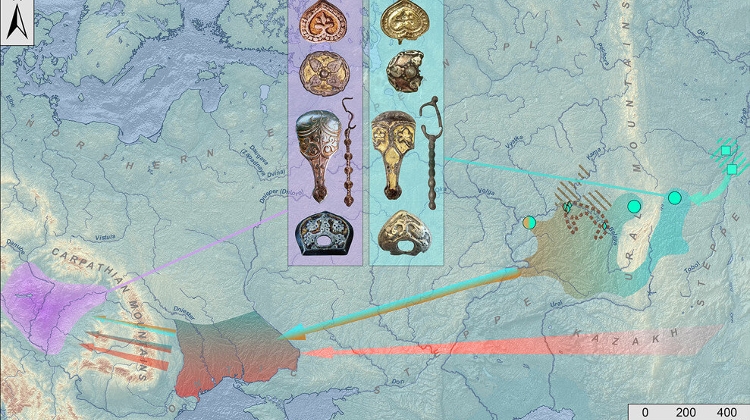
Results have "tightly link[ed] the Magyars to people of the early medieval Karayakupovo archaeological horizon," who lived in the southern Urals in the 8-10th century, the researchers said.
They also found genetic matches for peoples living along the Irtis and Tobol rivers in the 3-5th century, showing that Hungarians originated from western Siberia in the early centuries AD, the statement said.
Using a newly refined method to build genetic networks based on matching DNA segments, researchers found that the Karayakupovo peoples in the Volga-Ural region and some of the Magyars who arrived in the Carpathian Basin in the 8th-10th century formed a shared genetic network pointing to a large population linked through distant family relations, despite a distance of some 1,000km between the two populations, the statement said.
The Karayakupovo culture was "one of the most important sources" of Hungarians found in the Carpathian Basin in the 8th-10th century.
Karayakupovo communities were widespread on the Asian and European sides of the Urals by the 6th century AD, the research shows. Strong genetic links and Uralian genome found in medieval Hungarians show that they populated the Carpathian Basin relatively quickly, it said.
The study was led by Balazs Gyuris of the ELTE RCH Archaeogenomics Institute, who worked with Leonid Vyazov from Ostrava University and Attila Turk from the Pazmany Peter Catholic University, among others.
The project was coordinated by Anna Szecsenyi-Nagy (ELTE RCH) and David Reich (Harvard Medical School).
More:
cell.com
Source: MTI – Hungary’s national news agency since 1881. While MTI articles are usually factual, some may contain political bias, and readers should be aware that such content does not reflect the position of XpatLoop, which is neutral and independent.
Since the goal of XpatLoop is to keep readers well briefed, right across the spectrum of opinions, MTI items are shared to ensure readers are aware of all narratives within the local media.
XpatLoop believes in empowering readers to form their own views through complete and comprehensive coverage. To facilitate this XpatLoop has a balanced range of news partners, as you can see when you surf around XpatLoop.com
*********************************************************************************************
You're very welcome to comment, discuss and enjoy more stories via our Facebook page:
Facebook.com/XpatLoopNews + via XpatLoop’s groups: Budapest Expats / Expats Hungary
You can subscribe to our newsletter here: XpatLoop.com/Newsletters
Showcase Your Business to Expats in the Loop:
As an independent portal we’re grateful to all commercial supporters who help keep you in the loop with fresh insights and inspiration. Do you want your business to reach tens of thousands of potential high-value expat customers? If so please contact us here.



LATEST NEWS IN community & culture