












Updated: EU to Unlock Over Euro 15 Billion for Hungary
- 1 Jun 2026 10:39 AM
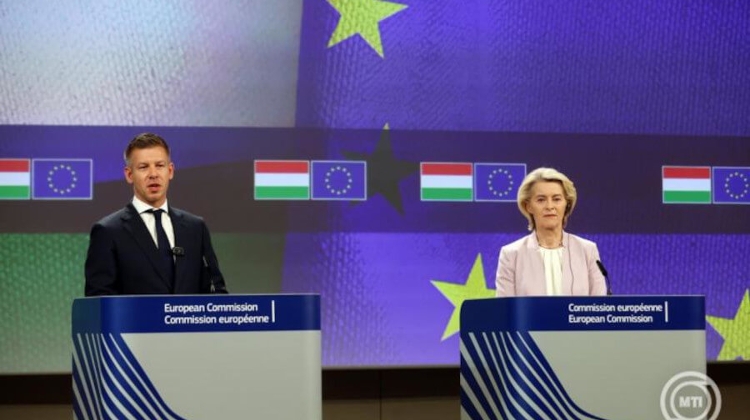
"We have agreed with the President of the European Commission on the release of 16.4 billion euros, approximately 6,000 billion forints, in EU funds," Prime Minister Peter Magyar announced in Brussels on Friday.
At a joint press conference with President of the European Commission Ursula von der Leyen, Magyar said one of their most important campaign promises was to bring home and unlock the many thousands of billions of forints in EU funding that is due to the Hungarian people, Hungarian companies, Hungarian public services, health care, education, transportation, and the social sector.
He said that of the 16.4 billion euros, 4.4 billion euros are cohesion funds, which the Hungarian government can spend on transport development, health-care investments, social investments, environmental investments, and support for small and medium-sized enterprises.
Some 2.2 billion euros will go towards education, development, and research, 1.5 billion euros will be allocated to the development of the electricity grid, and the government will be able to spend 2 billion euros on the procurement of new trains, suburban trains, and trams.
Magyar said that an agreement had been reached with the European Commission on all issues that would enable the Hungarian people to access the funds they are entitled to.
"On April 12, the people gave the government an unprecedented political mandate, just as they gave it the mandate to bring the funds home and kick-start an economy that has been unable to grow for four years, one that had the highest inflation in Europe, where we are currently struggling every day to keep public services from collapsing," he said.
"The goal was clear from the start; we negotiated very hard and fought for every euro cent," he said.
The real reason why the European Union was not in a position to provide Hungary with the many thousands of billions of forints it is entitled to was corruption, Magyar said, adding the level of corruption had long been at "unimaginable" levels in both the European Union and Hungary.
He added that he had said from the very beginning that if Hungary adopted anti-corruption measures, established the National Asset Recovery and Protection Office, strengthened the powers of the Integrity Authority, and adopted conflict-of-interest rules like other countries, "then these funds would come."
He said that a few weeks were enough to reach political agreement "on this enormous amount of EU funding".
Three or four weeks were enough to achieve "what [former Prime Minister] Viktor Orban and his outgoing government were unable to achieve in three or four years".
"Or perhaps they didn't even want to achieve it; we don't know," Magyar said.
Brussels did not have ideological expectations of Hungary regarding the release of European Union funds, but merely expected the "best possible action" against corruption, he said.
He added that what the commission president requested in the interest of European and Hungarian taxpayers could have been fulfilled long ago had the Orban government truly governed in the interest of the Hungarian people.
He said that the Tisza government advocated zero tolerance of corruption and, in certain cases, would adopt anti-corruption measures stricter than what had been requested.
As an example, he said the government would overhaul and tighten the asset declaration system, making it verifiable. The draft legislation is ready and includes a provision stating that anyone who intentionally provides false information in their asset declaration is punishable by up to two years in prison, he added.
The prime minister also noted his submission to the commission president of Hungary's application to join the European Public Prosecutor's Office.
"We are declaring zero tolerance for corruption. We will eliminate any opportunities for those in power to divert public assets into their own pockets, or to their oligarchs, or to their family members," he stated.
"This is a historic day for Hungary; a historic agreement has been reached, and we are working together with great joy for the future and competitiveness of Hungary and the European Union," Magyar said, adding that "this is a political agreement, a very strong signal."
"We will bring this money home, as we promised, to rebuild Hungary, jumpstart the economy, restore and develop public services, and strengthen the competitiveness of Hungarian companies and small and medium-sized enterprises," he said.
The negotiations with the European Commission and the commissioners were exclusively about unfreezing Hungarian EU funds and bringing EU money back to Hungary, and "no other topic was discussed between us," he said.
Answering a question, Magyar said public interest asset management foundations (KEKVAs) that do not oversee universities will be dissolved by the end of summer, fulfilling a milestone needed to access EU funds.
He said that regarding the KEKVAs, their agreement is that there will be a transition period until August 31, 2027, concerning the foundations overseeing universities.
There are some public benefit foundations that own hospitals, but the university itself is an institution that requires time for its ownership and operational structure to be transformed, he said.
Magyar said that public benefit foundations not affiliated with universities will be dissolved by Aug 31, including the Mathias Corvinus Collegium (MCC). The public functions of these institutions will be taken over by the state or the new owner, he added.
Meanwhile, regarding the rights of Hungarians living in Ukraine, Magyar said Hungary would like to receive guarantees that the 100,000 Hungarian citizens living in Transcarpathia can use their mother tongue again in schools, cultural institutions and administration.
Answering a question, the prime minister said there was no "link" between the release of Hungarian funds and Ukraine's EU accession or the opening of the first negotiating chapter.
He emphasised that professional talks are already under way between the Ukrainian and Hungarian sides. He highlighted that a 11-point proposal, mainly concerning educational, cultural and language rights, had been drawn up, and they are waiting for the Ukrainian side to implement it.
He added that it is a fundamental human right, in Europe and elsewhere, that wherever someone lives as a minority, they can use their mother tongue.
"Technically, the talks are very promising," he said, adding that he hoped the negotiations would be concluded soon and Ukraine would give a guarantee to transpose the 11 points into its own legislation. This could then be followed by an official meeting between the two foreign ministers, he added.
Magyar said he continued to maintain his offer that, after these issues are resolved, he would be happy to meet the Ukrainian president for a political agreement somewhere in Ukraine, preferably in Transcarpathia.
"We are ready to open a new chapter: I think now is the time to open a new chapter in Hungarian-Ukrainian relations. We would like to have good relations with all our neighbours," he declared.
On another subject, the prime minister said President Tamas Sulyok had not expressed any problems as regards the rule of law during the Orban government, "but now he does, when he fears for his own position and his multi-million-forint salary".
The president is turning to the Council of Europe's constitutional advisory body, the Venice Commission, with his complaint that the prime minister had repeatedly called on him to resign.
Magyar said that now, after the parliamentary election with the highest-ever turnout, which the Tisza Party won by a margin unseen since 1990, the president has started to fear for democracy and the rule of law, "even though he had no such concerns under [then Prime Minister] Viktor Orban's government".
Calling the president "Orban's puppet", Magyar insisted that Sulyok had not expressed any reservations about the rule of law when thousands of minors were "damaged in child protection, when Hungarian rule of law was hollowed out and destroyed, and when Orban placed his puppets in power everywhere".
"But now, when he fears for his own position and his multi-million-forint salary, the lawyer has suddenly become sensitive and has run off to the Venice Commission. Good luck with that!" he declared.
Magyar sent a message to Sulyok: he had until May 31 to resign and leave with his remaining dignity.
Magyar: Additional EUR 2 billion of funding unlocked in 'last hours' of talks
An additional 2 billion euros of European Union funding was unlocked during the "last hours" of talks in Brussels on Friday, Prime Minister Peter Magyar said in a post on Facebook on Saturday.
"We've come through some tough negotiations," Magyar said, calling the agreement reached on Friday to unfreeze a total of 16.4 billion euros of Hungary's EU funding "a historic victory".
"We will bring home every cent," he added.
Boka: 'What did Peter Magyar promise in exchange for EU funds?'
"What did [Prime Minister] Peter Magyar promise in exchange for EU funds?", the deputy leader of the opposition Fidesz parliamentary group said on Friday, reacting to Magyar's announcement that he and President of the European Commission Ursula von der Leyen had agreed to release 16.4 billion euros, approximately 6,000 billion forints, in EU funds.
Janos Boka, the former European affairs minister, said in a Facebook post that based on the announcement by Magyar and von der Leyen, "it is clear that the Hungarian prime minister has accepted the migration pact."
"This is bad news," Boka added.
He said what was interesting was something that neither of them mentioned: according to Boka, part of the EU funds due to Hungary had so far been withheld as a form of "political pressure" due to Hungary's stance on migration, the Russia-Ukraine war, and child protection.
"But these funds belong to the Hungarian people, and they would have received them in any case. The question now is: at what cost will they receive them," Boka said.
Magyar: Price of securing EU funds end to 'Orban-era corruption'
There was only one price that had to be paid for bringing home 6,000 billion forints (EUR 16.4bn) in EU funds: the complete elimination of [former Prime Minister Viktor] Orban-era corruption, the prime minister said on Facebook on Friday.
Peter Magyar added that the Hungarian government was happy to meet this condition.
He was responding to a Facebook post by Orban calling on him to disclose "what he sold out of Hungarian interests to Brussels" in exchange for the release of EU funds.
Orban calls on Magyar to disclose details of pact with von der Leyen
Former Prime Minister Viktor Orban and opposition Fidesz have called on Prime Minister Peter Magyar to "immediately disclose the details of the [President of the European Commission Ursula] von der Leyen - Magyar pact".
Orban and his party were reacting to the announcement on Friday by Magyar and von der Leyen that they had reached a political agreement on the release of 16.4 billion euros in EU funds allocated to Hungary.
"What did you sell out of Hungarian interests to Brussels?," Orban asked on Facebook, adding "there's no such thing as a free lunch."
In a comment attached to the post, Orban shared his party’s statement, showing that Magyar had reached a political agreement in Brussels regarding the return of EU funds due to Hungary that had been unlawfully suspended until now.
"We know this. What we don't know is what he promised in exchange," it said.
The Fidesz statement said that the Orban government had been negotiating with the EU for many years, so they are well aware of the list of demands from Brussels, which the previous cabinet always rejected.
They said they know that reaching a political agreement with Brussels was only possible if Magyar accepted the demands of the von der Leyen administration.
"We call on him to immediately inform the public about what the von der Leyen-Peter Magyar pact contains regarding migration, LGBTQ issues, the tax system, utility bill reductions, protected prices, and pensions," they said.
In another statement sent to MTI on Friday afternoon, Fidesz called it unacceptable that Hungary’s prime minister has repeatedly accused the previous government of corruption while abroad, most recently in Brussels.
"In contrast, the truth is that today we know for certain of only one case of corruption, and that was committed by Peter Magyar himself as head of the Student Loan Center," it said, adding that "moreover, he publicly admitted to committing the act of corruption".
Magyar: Brussels had no ideological expectations
Brussels did not have ideological expectations of Hungary regarding the release of European Union funds, but merely expected the "best possible action" against corruption, Prime Minister Peter Magyar said in Brussels on Friday after a meeting with President of the European Commission Ursula von der Leyen.
Magyar said that what the commission president requested in the interest of European and Hungarian taxpayers could have been fulfilled long ago had the government of former Prime Minister Viktor Orban truly governed in the interest of the Hungarian people.
He said that the Tisza government advocated zero tolerance of corruption and, in certain cases, would adopt anti-corruption measures stricter than what had been requested.
As an example, he said the government would overhaul and tighten the asset declaration system, making it verifiable, adding that the draft legislation is ready and includes a provision stating that anyone who intentionally provides false information in their asset declaration is punishable by up to two years in prison.
The prime minister also noted his submission to the President of the European Commission of Hungary's application to join the European Public Prosecutor's Office.
Karacsony: Budapest partner in smart use of EU funds
Budapest is a partner and ally to the central government in ensuring that the EU funds finally arriving in Hungary are used wisely and for the future, Budapest Mayor Gergely Karacsony said in a Facebook post on Friday.
"The return of EU funds is a big deal and a real cause for joy, and fulfilling the rule-of-law conditions attached to them is in Hungary's interest," the mayor wrote after Prime Minister Peter Magyar announced that Hungary agreed with the European Commission president on the disbursement of a significant part of the EU funds due to Hungary.
The mayor insisted that Budapest was capable and suitable for receiving significant EU funds for development purposes.
Budapest's plans, he added, focused on how to strengthen the capital's resilience against the housing and climate crises, and how to preserve the city's liveability for future generations.
Plans for tapping the most urgent Recovery Fund resources fall into four main groups: housing programmes, transport development, public space renewal programmes and green investments, he said.
Karacsony said a Budapest renovation programme for density housing would help to reduce housing costs, reduce emissions and provide work for Hungarian businesses. Also, a project is under way to convert non-residential properties into housing, he added. This also includes support for the planned housing construction at the brownfield Rakosrendezo site, he added.
The transport package includes connecting Buda and Pest tram networks, as well as purchasing new trams, trolleybuses and electric buses, he said.
Fully 60 new CAF trams, 160 trolleybuses and 250 electric buses could arrive in the city from these funds, he added.
The mayor also mentioned a project to renovate the HEV suburban railway and the development of agglomeration rail transport.
He also noted public space renewal, with EU funds to be used to expand the Healthy Streets programme, already launched with resources acquired by the municipality, and the planned revamp of Ring Road and the Embankments.
At the same time, their green development projects that can be financed from EU money include a series of large-scale green area development projects, including the City Park and Varosmajor Park, among others, he added.
MTI Stock Photo
Source: MTI – Hungary’s national news agency since 1881. While MTI articles are usually factual, some may contain political bias, and readers should be aware that such content does not reflect the position of XpatLoop, which is neutral and independent.
Since the goal of XpatLoop is to keep readers well briefed, right across the spectrum of opinions, MTI items are shared to ensure readers are aware of all narratives within the local media.
XpatLoop believes in empowering readers to form their own views through complete and comprehensive coverage. To facilitate this XpatLoop has a balanced range of news partners, as you can see when you surf around XpatLoop.com
*********************************************************************************************
You're very welcome to comment, discuss and enjoy more stories via our Facebook page:
Facebook.com/XpatLoopNews + via XpatLoop’s groups: Budapest Expats / Expats Hungary
You can subscribe to our newsletter here: XpatLoop.com/Newsletters
Showcase Your Business to Expats in the Loop:
As an independent portal we’re grateful to all commercial supporters who help keep you in the loop with fresh insights and inspiration. Do you want your business to reach tens of thousands of potential high-value expat customers? If so please contact us here.



LATEST NEWS IN current affairs