




















Update: Extreme Heat Warning Issued in Hungary - 'Most Dangerous'
- 30 Jun 2026 8:05 AM

Hungary's chief medical officer has declared a third-degree heat alert for the entire country from Saturday, warning of extreme temperatures for at least four consecutive days.
Update:
Hungary's chief medical officer has extended the nationwide third-degree heat alert until midnight on Wednesday, authorities said.
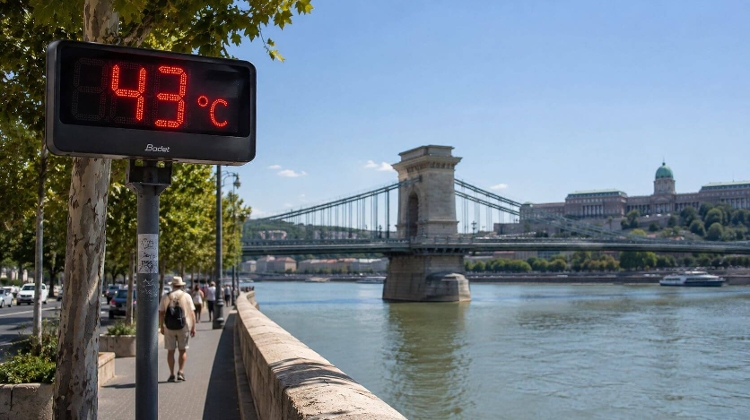
Temperatures are expected to remain persistently high, nearing 40 degrees Celsius in some places, they said.
Meanwhile, the prime minister has asked residents to observe restrictions concerning water supply and to reduce their water consumption.
Speaking in Parliament, Peter Magyar noted that water shortages were reported from more and more places in the country, and singled out Godollo, east of Budapest, an area with "record high" water consumption, saying "we should not wait until the supply system breaks down."
Magyar said that another one or two more days were forecast in what he called an unprecedented heat wave, adding that people should use as little water as possible "rather than fill up pools or water plants because that would lead to immense problems".
Earlier:
Addressing a government press briefing on Thursday, Beatrix Oroszi asked Hungarians to look after themselves, their families and the people around them over the coming days.
The second-degree heat alert currently in effect will be raised to a third-degree alert from midnight on Saturday, she said.
The daily average temperature is expected to exceed 29 degrees Celsius for at least four consecutive days, with daily highs potentiall hitting 38-40 degrees Celsius in some regions, she added.
Citing forecasts, Oroszi said the current heat wave is expected to be the most intensive and most dangerous one of the year, "something we haven't seen over the last 20 years".
She said the heat posed a danger to the elderly, infants, young children, pregnant women, those with cardiovascular or respiratory conditions, diabetes, people with limited mobility, the homeless and those doing outdoor physical work.
Oroszi advised the public to drink more then usual, preferably water, avoid alcohol and caffeine, stay indoors between 11am and 4pm, and to wear loose clothing.
The medical officer warned against leaving children, elderly people or pets inside parked cars, adding that people should swim only in designated areas, and avoid jumping into water when overheated.
Meanwhile, Oroszi warned that the heat wave will place a significant burden on the health-care system, with up to 400-450 additional emergency calls daily, increased demand in emergency departments, and a potential doubling of accident-related ambulance calls.
She also urged social services to pay special attention to the elderly and most vulnerable.
Pal Kadar, the head of the Defence Management Office, said Hungary's energy consumption is currently at 95 percent of its all-time peak, but there is no energy supply crisis requiring emergency intervention.
He said water distribution points and sprinkler gates are already operational across the country. On Wednesday, the office and its partners set up 346 water distribution sites, with 2,001 people distributing over 25,250 litres of water, he said.
Kadar urged organisers of weekend events to ensure safety and review their plans in light of the extreme heat.
He added that rail services have already introduced some track and speed restrictions, with updates available on official information channels.
State railway company MAV is also continuing its water distribution programme, having handed out 15,000 half-litre bottles on Wednesday, he said.
Kadar said the Defence Management Office serves as an information hub, coordinating data and measures to support the government’s work.
The office, he said, compiles reports and data from water utility providers, local governments, regional defence committees, meteorological services, transport organisations and other service providers.
Magyar: Govt orders coordinated heat wave response
The government has issued a decree on the coordinated protection action prompted by the extreme heat in Hungary, the prime minister told a regular press briefing on Thursday.
Peter Magyar said he was heading the protection efforts with a coordination body aiding his work, consisting of the ministers of the interior, health, economy and energy, defence, transport and innovation, as well as the chief advisor on national security.
Magyar called on the public to "follow the news on the heat alert, stay at home if possible and especially take care of the elderly around you."
Local defence committees will coordinate efforts across sectors, including the military, disaster response teams, ambulance services and fire brigades. The Defence Management Office will provide continuous updates to the government, he added.
From midnight on Friday, regular updates will be provided on the government website kormany.hu as well as the government's Facebook page, he said. Magyar asked the public to monitor these platforms and follow news reports.
The government will keep monitoring the situation at a three-day informal cabinet meeting in Pilisszentkereszt, near Budapest, he said, adding that they would take immediate action if needed.
Meanwhile, he said the government has ordered remote work for state administration and state-owned companies on Monday and Tuesday where possible.
He reminded employers of their duty to ensure safe working conditions, including providing protective drinks, and urged them to consider shortened work schedules and rescheduling outdoor work.
The military, local councils and charities are distributing bottled water nationwide in public spaces, at train and bus stations, and along highways in case of traffic jams. The military has also been ordered to produce and stockpile millions of bottled water at key locations, he added.
In emergencies, the Hungarian military and national water works can deploy 26 mobile units to provide water across the country, Magyar said, adding, however, that because this capacity is low, authorities have been ordered to develop plans to expand it.
Social institutions are being equipped with mobile air conditioning units, and repairs are ongoing in hospitals and care facilities, Magyar said, adding that no serious issues have been reported so far.
Outreach teams are assisting the homeless, who are most at risk, with crisis vehicles patrolling public areas.
Magyar called on local councils to keep air-conditioned municipal offices open to the public over the weekend, and urged shops and restaurants to provide free drinking water and access to restrooms.
Over 2,200 air-conditioned public spaces are available nationwide, with a full list on the government and disaster management websites, he said.
Magyar also said disaster response and military units will be present at major events to provide water and cooling measures if needed.
He also noted that temporary suspension of the truck stop ban has been introduced.
Magyar warned of likely speed restrictions on railways due to track overheating, with possible cancellations, including on suburban lines.
On drought damage, Magyar said the issue was discussed in recent cabinet meetings, and state secretary Szabolcs Bona has proposed reallocating funds for compensation.
He said much larger investments were needed, and the government has requested a medium- and long-term climate, water management, and irrigation strategy by early autumn.
Earlier:
The cabinet has adopted a government decree to coordinate protection activities in response to the heat wave alert, Prime Minister Peter Magyar said on Thursday during a tour of the Uzsoki Street Hospital in Budapest accompanied by Health Minister Zsolt Hegedus.
Magyar said on Facebook that he will be overseeing the efforts.
Starting early on Saturday morning, a Level 3 (red) heat alert will be in effect across most of the country due to the heat, Magyar said.
According to weather forecasts, the daily average temperature is expected to exceed 29 degrees for four consecutive days, a situation unprecedented in Hungary since temperature records began, he added.
Magyar said that the health-care system, the fire department, the transport system, and the general public will all be under extraordinary strain.
The prime minister said the protection efforts will be coordinated by the Defence Management Office, and that a government decree on the matter will soon be published in the official gazette Magyar Kozlony.
Magyar added that he will personally lead the effort, supported by the defence, interior, health, transport, economic, and national security ministers.
He noted that a coordination meeting was already held on Thursday morning to assess the situation and issue necessary instructions.
Magyar emphasised the need for preparedness, as mass events and sporting events are scheduled nationwide over the weekend.
Further details will be announced at a government press briefing starting at 3pm, which will also be attended by Transport and Investment Minister David Vitezy, the chief medical officer, a fire service representative and a Defence Management Office leader.
Magyar said he was conducting an inspection at the Uzsoki Street Hospital accompanied by the health minister because it was the first health-care facility where, following a decision by the Tisza government and as a result of an investment of more than 130 million forints (EUR 370,000), the replacement of the liquid coolers had been completed.
He noted that one of the Tisza government's first acts was to reallocate over 3.6 billion forints in emergency funding to replace and upgrade hospital air conditioning systems, enabling work to begin in 32 hospitals.
Hegedus said a comprehensive audit of hospital cooling systems had been ordered immediately after the government's formation, leading to the reallocation of funds. He said the difference between the previous and current government was that the Tisza government "is honestly addressing this issue and developing a long-term strategy for hospital air conditioning."
The minister also announced that a system to measure and publish hospital infection rates will be launched in September.
He said transparency was one of the most important factors, adding that the government was doing everything possible to ensure Hungarians receive "modern, European-level high-quality health care".
Andrea Ficzere, director of Uzsoki Street Hospital, said that while cooling has been resolved in 12 operating theatres in one building, three trauma surgery rooms remain extremely hot due to broken cooling systems.
The oncology building's fan-coil system has also failed, creating significant challenges for radiation therapy patients.
Magyar and Hegedus climbed a fire escape to the hospital’s roof to inspect the new cooling equipment.
He presented details of the ongoing upgrades at various health-care insitutions.
Magyar also said he had given the chief public prosecutor until 3pm on Thursday to report on the ongoing investigation into the "gold convoy" case involving the way the authorities under the previous government stopped the transport of money and gold assets to Ukraine.
He added that "almost everyone in Hungary is interested" in who has been questioned so far as suspects in the gold convoy case, and what happened in recent weeks.
"If the report is not provided, then after 3pm I will share some rather interesting and important information that is available to us," Magyar said.
At a press conference on Monday, the prime minister said he expected the chief prosecutor to resign shortly.
Responding to a question from a public media reporter at the time, he confirmed that the resignation could be related to the gold convoy case.
Magyar said then that if the resignation does not take place, they will return to the question of how to remove Gabor Balint Nagy from office.
MTI Stock Photo
Source: MTI – Hungary’s national news agency since 1881.
*********************************************************************************************
You're very welcome to comment, discuss and enjoy more stories via our Facebook page:
Facebook.com/XpatLoopNews + via XpatLoop’s groups: Budapest Expats / Expats Hungary
You can subscribe to our newsletter here: XpatLoop.com/Newsletters
Showcase Your Business to Expats in the Loop:
As an independent portal we’re grateful to all commercial supporters who help keep you in the loop with fresh insights and inspiration. Do you want your business to reach tens of thousands of potential high-value expat customers? If so please contact us here.



LATEST NEWS IN health & wellness